March 2026
Closing the First-Response Gap in Aquaculture Spill Incidents
In marine aquaculture, the margin between a manageable operational incident and a serious environmental event is often measured in minutes. Fuel transfers, hydraulic hose failures, minor vessel collisions, and routine maintenance mishaps are part of working on water. When they occur within a farming grid, however, even a relatively small diesel release can spread rapidly across pens and mooring systems, adhering to nets and floats before crews fully assess the situation.
Once contamination begins moving through a site, consequences escalate quickly. Stock may be exposed or tainted. Nets and collars can require cleaning or replacement. Regulators may require formal reporting and follow-up investigations. Production schedules are disrupted, staff are diverted from core operations, and the reputational impact can extend far beyond the physical footprint of the spill.
For many operators, the true cost of an incident is not determined by the volume released, but by how quickly containment begins.
The difficulty is that many aquaculture sites are remote and environmentally exposed. External spill response contractors may be hours away. Weather conditions can delay access. Traditional containment systems designed for ports and terminals often require cranes, specialized vessels, or larger crews to deploy. In practice, the outcome of most marine farming incidents is decided long before outside assistance arrives.
This period — the first five to fifteen minutes following detection — represents what operators increasingly recognize as the critical response gap.
Historically, spill response planning has focused on mobilizing significant equipment once an event is confirmed. While appropriate for large industrial releases, that model does not always align with the operational realities of fish farming. At a working aquaculture site, the priority is immediate source isolation. Preventing spread while the spill footprint is still small dramatically reduces downstream impact.
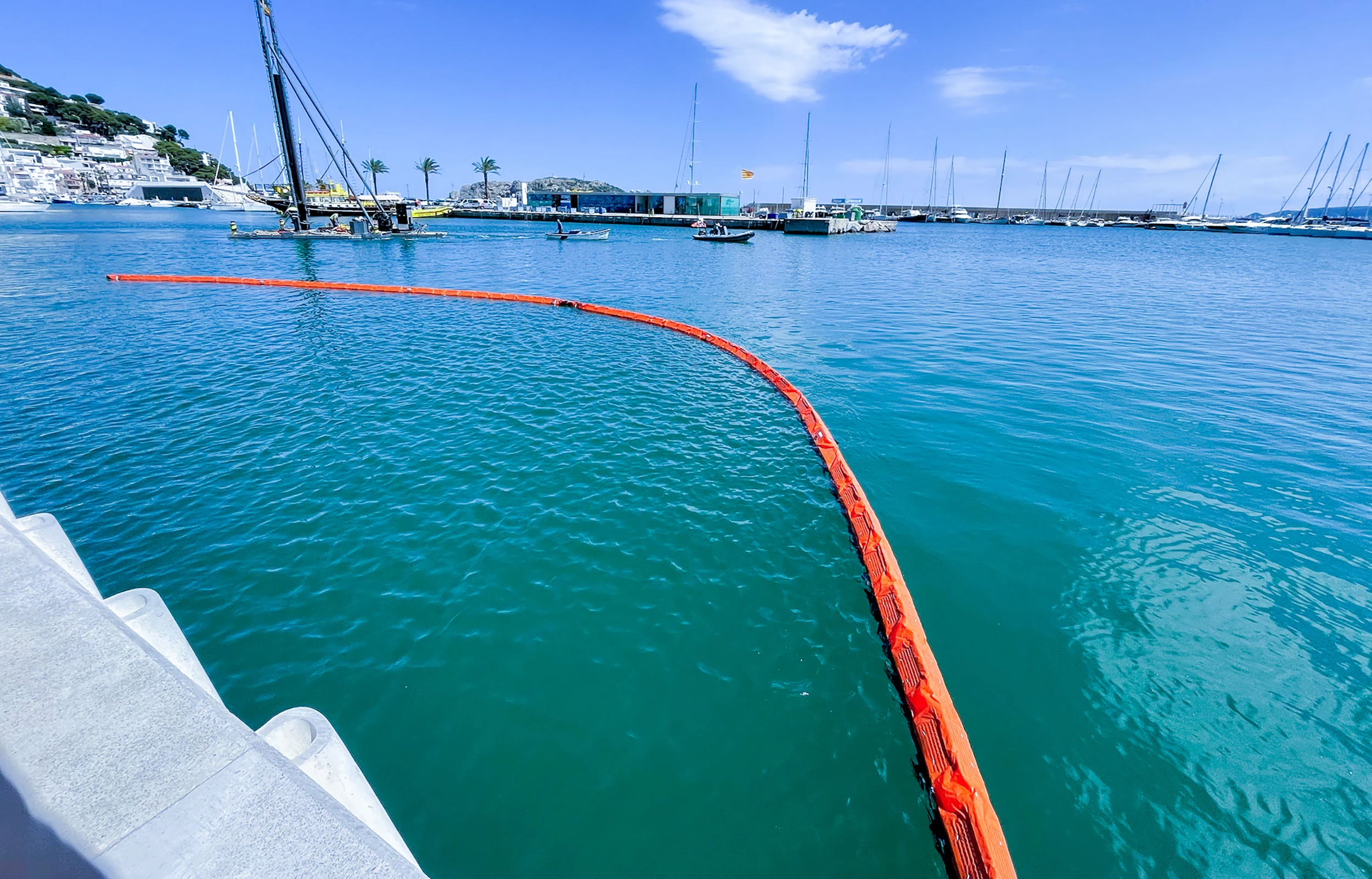
In response to this need, a new category of lightweight, modular containment systems has emerged. Systems such as the HARBO T6 UHD, originally developed for rapid deployment in industrial and port environments, are now being integrated into aquaculture response planning. Unlike conventional boom stored in large reels or containers, cartridge-based systems can be staged directly at fuel transfer areas, service wharves, or barge landing points and deployed by one or two crew members without heavy lifting equipment.
Because they can be launched from small workboats or directly from a dock, containment can begin within minutes. Operational exercises conducted in cooperation with regional authorities have demonstrated this in practical terms. In one recent drill, a containment cartridge staged on a wharf enabled fifteen meters of boom to be deployed in approximately six minutes. In dynamic marine conditions, that time difference can determine whether contamination remains localized around a vessel or spreads across an entire pen array.
Engineering considerations are equally important. Aquaculture farms are rarely located in calm basins. Many operate in tidal channels or exposed coastal zones where wind and current are constant variables. Containment systems must balance compact storage and rapid deployment with the structural integrity required to function in active water. Systems that are too light to maintain position are ineffective, while systems that are too heavy or complex to deploy create delay. Designs like the HARBO platform seek to address this balance by combining high-density storage with durability in moving water, enabling realistic first response rather than theoretical capability.
Another development shaping the future of spill preparedness in aquaculture is the growing integration of automation. Farms are increasingly incorporating remote monitoring, sensor networks, and automated feeding systems. It is a natural progression to examine how autonomous or remotely operated surface vessels may assist in environmental response. Lightweight containment systems can be positioned or towed by small unmanned platforms, allowing rapid deployment without exposing crew to hazardous conditions. When paired with compact boom systems, autonomous vessels offer the potential for faster source isolation and improved maneuverability within tight pen configurations.
Regulatory expectations are also evolving. Across global aquaculture markets, authorities are placing greater emphasis on demonstrated preparedness and environmental stewardship. The ability to show documented, on-site first-response capability — rather than reliance solely on external contractors — strengthens compliance posture and reflects operational maturity.
Ultimately, the shift underway is one of mindset. Spill response in aquaculture is moving from a model centered on large-scale mobilization toward one focused on immediate intervention. The goal is not simply to respond effectively, but to respond instantly.
In an industry built upon the health of the marine environment, closing the first-response gap may prove to be one of the most important operational advancements of the coming decade.